

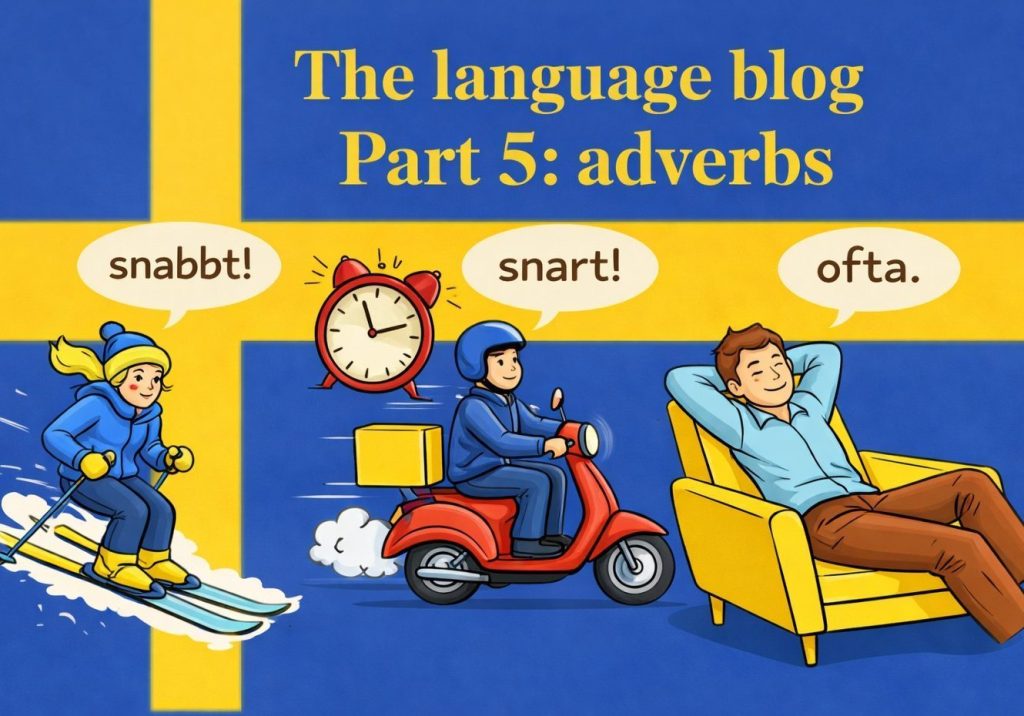
Swedish adverbs: time, place, direction and the small words that change everything
Adverbs are small but they carry a lot of weight in Swedish. They do the quiet work of telling us when something happens, how often, where, in which direction, and — perhaps most importantly — what the speaker actually thinks about the whole thing. Get them right, and your Swedish sounds noticeably more natural. Get them slightly wrong, and the meaning of a sentence can flip without you noticing.
In this part of our Learn Swedish series, we will look at the most useful Swedish adverbs for everyday life and the workplace — the kind of adverbs that come up between 07.30 and 18.00 in any Stockholm office. As usual, you will find audio files so you can listen, repeat and practise pronunciation. The grammatical explanations are based on Svenska Akademiens grammatik.
Why adverbs matter — even before you’ve learned them all
Before we open the toolbox, four quick examples of what adverbs actually do:
Jag spelar ofta tennis. — I often play tennis. (frequency) Vi kan ses där om tjugo minuter. — We can meet there in twenty minutes. (place) Jag studerade hårt. — I studied hard. (manner) Jag gillar verkligen dig. — I really like you. (emphasis) Jag kommer inte på festen. — I’m not coming to the party. (negation)
That last one is worth pausing on. Inte — the most consequential four-letter word in Swedish. We’ve taught students who could give a perfect ten-minute presentation in Swedish but kept misplacing inte in the sentence and saying the opposite of what they meant. We will come back to that.
Swedish adverbs of time
Some of the very first adverbs you need are the ones that anchor a sentence in time.
Swedish | English |
|---|---|
nu | now |
då | then |
i dag | today |
i går | yesterday |
i förrgår | the day before yesterday |
i morgon | tomorrow |
i övermorgon | the day after tomorrow |
These come up constantly in workplace Swedish — Jag kommer i morgon, Vi träffades i går, Jag är upptagen i dag. They are short, they are frequent, and they are non-negotiable.
How often: adverbs of frequency
Swedish | English |
|---|---|
alltid | always |
ofta | often |
ibland | sometimes |
sällan | rarely |
aldrig | never |
när som helst | whenever / at any time |
Jag tränar ofta. — I often exercise. Hon kommer aldrig för sent. — She is never late. Vi kan träffas när som helst. — We can meet whenever.
If you take Swedish lessons for companies, these are the adverbs that quietly transform your stand-up updates and your weekend small talk in the office kitchen.
Connecting two points in time: igen, redan, fortfarande
Jag vill försöka igen. — I want to try again. Han har redan gått hem. — He has already gone home. Jag bor fortfarande i Stockholm. — I still live in Stockholm.
Small words, big meaning. Fortfarande is a particular favourite of expats who have lived here for years and want to express, with one word, a slightly tired but affectionate “yes, I’m still here.”
Listen and repeat: Swedish adverbs of time
Jag går ofta till gymmet. Vi träffades i går. Jag kommer tillbaka i morgon. Hon jobbar fortfarande här. Vi har redan ätit lunch. Jag vill försöka igen.
Last Wednesday, last spring, last Christmas — the -s trick
A genuinely charming feature of Swedish: add -s to weekdays, seasons and holidays, and you get “the most recent one.”
Swedish | English |
|---|---|
vår → i våras | last spring |
onsdag → i onsdags | last Wednesday |
jul → i julas | last Christmas |
Jag började kursen i våras. Vi sågs i onsdags. Jag var i Göteborg i julas.
This is one of those small features of everyday Swedish for expats in Stockholm that makes a real difference. The first time a student drops i onsdags into a Monday morning conversation without thinking, the whole tone of the small talk shifts.
Position and direction: är vs går
Here is one of the areas where Swedish grammar genuinely splits from English. In English, home is home whether you are sitting in it or running to it. In Swedish, we use different adverbs depending on whether something is located somewhere or moving somewhere.
A simple rule:
- Use position adverbs with verbs that don’t move: är, bor, sitter, står.
- Use direction adverbs with verbs that do: går, åker, kommer, springer.
English | Position | Direction (to) | From |
|---|---|---|---|
home | hemma | hem | hemifrån |
there | där | dit | därifrån |
here | här | hit | härifrån |
inside / in | inne | in | inifrån |
outside / out | ute | ut | utifrån |
This is the area where we see the most “almost-right” Swedish. Jag går hemma sounds a bit odd — it suggests pacing around the apartment. Jag är hem sounds equally odd in the opposite direction. Both are clearly the work of someone whose ear is still tuning in. A few weeks of focused practice and the distinction usually clicks.
Listen and repeat: position and direction
Jag är hemma. — I am at home. När kommer du hem? — When are you coming home? Jag jobbar hemifrån i dag. — I’m working from home today. Ska vi ses där klockan tre? Kan du gå dit efter jobbet? Kom hit! Vi är inne nu. Vi åker hemifrån klockan åtta.
That last sentence — Jag jobbar hemifrån i dag — is one of the most useful workplace Swedish sentences of the post-pandemic era. Worth memorising.
Sentence adverbs: the small words that change the whole sentence
Sentence adverbs aren’t really about what happened. They are about how the speaker wants you to interpret what happened. A few common ones:
Jag spelar inte piano. — I don’t play. (negation) Jag spelar kanske piano. — Maybe I play. (uncertainty) Jag spelar bara piano. — Only piano. (limitation) Jag spelar absolut piano. — I definitely play. (emphasis) Jag spelar också piano. — I also play. (addition)
Five different sentences, almost identical word order, completely different meanings. If you are learning Business Swedish for meetings, these five small words alone will sharpen everything you say.
The famous trio: nog, väl, ju
These three adverbs are difficult to translate because they don’t really translate. They communicate the speaker’s attitude — what the speaker knows, what the speaker thinks the listener knows, and how confident anyone is.
Nog signals that the speaker is fairly sure but not certain.
Jag kommer nog på festen. — I’ll probably come to the party.
Väl signals that the speaker expects the listener to confirm.
Du kommer väl på festen? — You’re coming to the party, right?
Ju signals that the information is shared, obvious, or already known.
Jag kommer ju på festen! — (But of course) I’m coming to the party!
If you have ever sat in a Swedish meeting and felt that something subtle was happening that you couldn’t quite name, nog, väl and ju are very often what was happening. They are the connective tissue of Swedish workplace conversation. We spend a fair amount of time on them in our Swedish lessons for companies, because once you start hearing them you can’t stop.
Listen and repeat: sentence adverbs
Jag kommer nog senare. Du vet väl att mötet börjar klockan nio? Det är ju viktigt! Jag har inte tid i dag. Hon kanske kommer i morgon. Jag vill bara hjälpa till. Jag gillar verkligen svenska.
How adverbs modify verbs, adjectives and other adverbs
Adverbs are flexible. They can modify a verb (Han springer snabbt), another adverb (Han springer väldigt snabbt), or an adjective (Han är väldigt snabb).
A common pattern: many Swedish adverbs are formed by adding -t to an adjective.
Adjective | Adverb |
|---|---|
snabb | snabbt |
långsam | långsamt |
tydlig | tydligt |
vanlig | vanligt |
Hon talar tydligt. — She speaks clearly. Han kör långsamt. — He drives slowly.
Comparing adverbs
Just like adjectives, many adverbs can be compared:
Positive | Comparative | Superlative |
|---|---|---|
fort | fortare | fortast |
ofta | oftare | oftast |
gärna | hellre | helst (irregular) |
Jag dricker gärna kaffe. — I’m happy to drink coffee. Jag dricker hellre te. — I would rather drink tea. Jag dricker helst vatten. — I prefer water most of all.
And two structures worth memorising as a unit:
längre än — longer than lika länge som — as long as
Han har jobbat här längre än jag. Han har jobbat här lika länge som jag.
In spoken Swedish you will hear längre än mig and lika länge som mig. In writing, jag is generally preferred.
Question adverbs
Swedish | English |
|---|---|
när? | when? |
hur? | how? |
var? | where? |
vart? | where to? |
varifrån? | from where? |
varför? | why? |
När börjar lektionen? Var bor du? Vart ska du? Varifrån kommer du?
The classic stumbling block here is var versus vart. Var är du? (Where are you?) versus Vart ska du? (Where are you going?). In modern spoken Swedish many people use vart for both — but in standard written Swedish, the distinction still pulls its weight.
And finally: lagom
No article on Swedish adverbs is complete without lagom.
Lagom means just right — not too much, not too little.
Kaffet är lagom varmt. — The coffee is just warm enough. Det är lagom svårt. — Just the right level of difficulty. Vi har lagom mycket att göra. — Just the right amount to do.
It is a small word that says a lot about Swedish culture. We sometimes joke in our lessons that if a student starts using lagom unprompted, with the right shrug, they have crossed an invisible line into something very close to fluency.
Practising adverbs in real life
Adverbs are a small area with an outsized effect. They tighten your sentences, they make your tone more accurate, and they are exactly the kind of thing that lifts Swedish from “correct” to “natural.”
If you are an expat in Stockholm, an international employee at a Swedish company, or an HR manager looking for Swedish lessons for companies, this is one of the highest-leverage areas to work on. Adverbs come up in every meeting, every email and every coffee break.
At Albrechts Kommunikation, we offer Swedish lessons in Stockholm — online, on-site or hybrid — and we tailor lessons for individuals, IT teams and companies who want their international employees to feel more at home in Swedish. We don’t teach grammar in the abstract; we teach it through the Swedish that actually fills a working day.
If this sounds useful for you or your team, get in touch. Ha en fortsatt fin vecka. Vänliga hälsningar, Albrechts Kommunikation.