
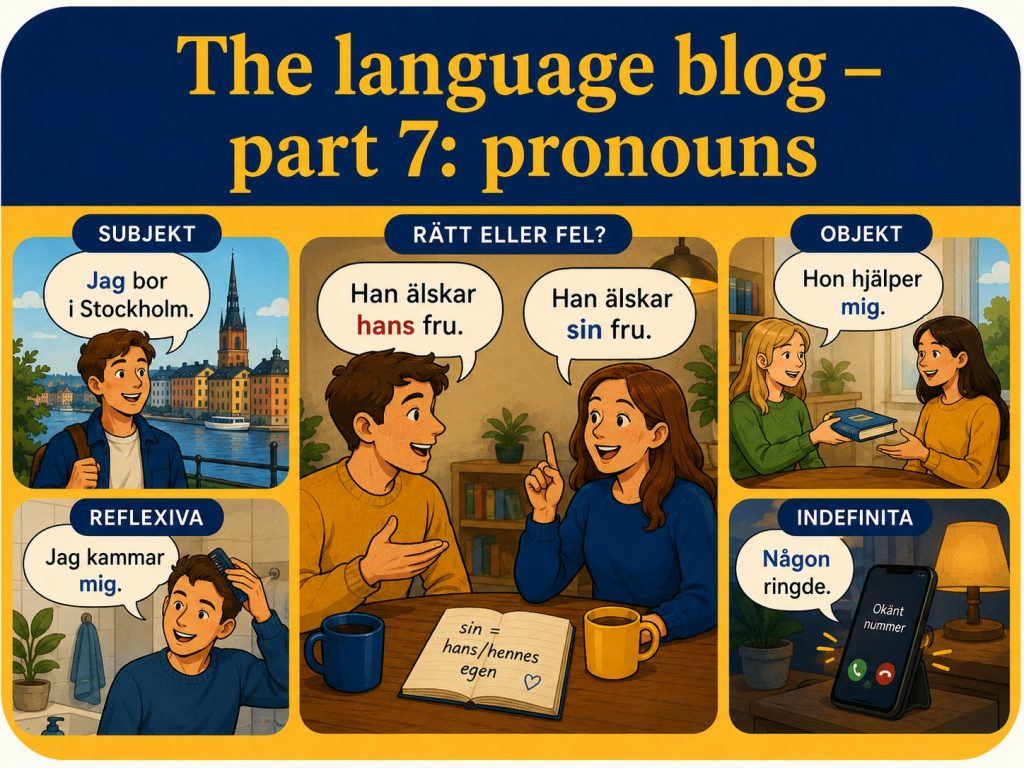
Hi again!
We’ve now reached the final part of our blog series, where we’ve explored the main word classes in Swedish – yay!
As always, we’ll summarise what you need to know using useful everyday examples and audio files, so you can listen, practise and review whenever you like.
Pronouns may look simple at first, but they are extremely useful. You need them when you introduce yourself, talk about other people, describe relationships, explain who owns something, and understand everyday Swedish at work, at school or in social situations.
If you are taking Swedish language classes, Swedish lessons in Stockholm, or learning Swedish for expats and workplace situations, pronouns are one of the grammar areas that quickly make your Swedish sound more natural.
Let’s begin with the basics.
Subject pronouns in Swedish
Subject pronouns often tell us who is doing something.
| Swedish | English | Examples (audio below) |
|---|---|---|
| jag | I | Jag arbetar i Stockholm. |
| du | you | Du pratar svenska. |
| han | he | Han kommer från Spanien. |
| hon | she | Hon läser ett mejl. |
| den | it/that | Den är dyr. |
| det | it/that | Det är viktigt. |
| vi | we | Vi har ett möte. |
| ni | you | Ni kan börja nu. |
| de | they | De jobbar tillsammans. |
A few details are worth noticing.
In English, you can mean one person or several people. In Swedish, we usually separate them:
du = one person
ni = several people
So if you speak to one colleague, you say:
Kan du hjälpa mig?
Can you help me?
If you speak to a group, you say:
Kan ni hjälpa mig?
Can you help me?
In modern Swedish, du is the normal form when speaking to one person, even in most professional situations. Swedish workplaces are often quite informal compared with many other cultures.
Also notice den and det. Both can mean it, but Swedish uses den for en-words and det for ett-words:
En bok → Den är bra.
Ett möte → Det är viktigt.
Object pronouns in Swedish
Object pronouns are used when someone or something receives the action.
| Object | English | Examples (audio below) |
|---|---|---|
| mig | me | Hon hjälper mig. |
| dig | you | Jag känner dig. |
| honom | him | Jag ringde honom igår. |
| henne | her | Vi träffade henne på jobbet. |
| den | it | Jag köpte den igår. |
| det | it | Kan du ge mig det? |
| oss | us | Chefen bjöd oss på lunch. |
| er | you | Jag skickade ett mejl till er. |
| dem | them | Jag såg dem på stationen. |
Compare subject with object pronouns:
Jag ringer honom.
I call him.
Hon hjälper mig.
She helps me.
Vi väntar på er.
We are waiting for you.
De såg oss på kontoret.
They saw us at the office.
In spoken Swedish, de and dem are pronounced dom. In writing, you will normally see de as the subject and dem as the object.
De hjälper dem (‘dom hjälper dom’) They help them.
Reflexive pronouns: mig, dig, sig, oss, er, sig
Now we come to a very important group: reflexive pronouns. Reflexive pronouns often show who is affected by an action:
Hon kammar henne. → She is combing her.
Hon kammar sig. → She is combing herself.
However, Swedish also uses reflexive pronouns in many situations where English does not. For example:
Hon gifte sig.
Literally: She married herself.
Of course, that is not what the sentence means. It simply means She got married. In Swedish, many common verbs are reflexive even though the action is not really directed back at the subject in the way English speakers might expect.
A reflexive pronoun means that the subject and the object are the same person.
Here is the basic table:
| Subject | Reflexive form | Examples (audio below) |
|---|---|---|
| jag | mig | Jag kammar mig. |
| du | dig | Du sätter dig. |
| han | sig | Han rakar sig. |
| hon | sig | Hon skämde ut sig. |
| den/det | sig | Det kommer att visa sig. |
| vi | oss | Vi lär oss svenska. |
| ni | er | Ni bestämmer er. |
| de | sig | De skyndar sig. |
The important rule is this:
In the first and second person, singular and plural, Swedish uses the object pronouns:
jag → mig
du → dig
vi → oss
ni → er
But in the third person, Swedish always uses sig, both singular and plural:
han tvättar sig
he washes himself
hon skämde ut sig
she embarrassed herself
de bestämde sig
they decided
Many common Swedish verbs are reflexive:
känna sig – to feel
lära sig – to learn
skynda sig – to hurry
bestämma sig – to decide
sätta sig – to sit down
lägga sig – to go to bed / lie down
This is one reason why reflexive pronouns are so important in everyday Swedish and Business Swedish. You will hear them all the time.
Possessive pronouns in Swedish
Possessive pronouns show ownership or connection: my, your, his, her, our, their.
| Person | Swedish | English |
|---|---|---|
| jag | min / mitt / mina | my |
| du | din / ditt / dina | your |
| han | hans | his |
| hon | hennes | her |
| den/det | dess | its |
| vi | vår / vårt / våra | our |
| ni | er / ert / era | your |
| de | deras | their |
The forms min, mitt and mina change depending on the noun:
min bok
my book
mitt hus
my house
mina kollegor
my colleagues
The same pattern appears with din, vår and er:
din fråga
your question
ditt svar
your answer
dina idéer
your ideas
vår kurs
our course
vårt möte
our meeting
våra lektioner
our lessons
This is useful in workplace Swedish because you often need to talk about your role, your tasks, your team and your meetings.
Sin, sitt, sina – a very Swedish detail
Now we come to one of the most important pronoun patterns in Swedish: sin, sitt and sina.
These forms mean his own, her own, its own or their own.
They refer back to the subject in the same clause.
| Form | Used with | Example |
|---|---|---|
| sin | en-words | Hon älskar sin hund. |
| sitt | ett-words | Han läser sitt mejl. |
| sina | plural | De tar med sina datorer. |
The form depends on the noun, not on the person.
sin hund
because en hund
sitt hus
because ett hus
sina saker
because plural
Now look at the difference:
Anna älskar sin hund.
Anna loves her own dog.
Anna älskar hennes hund.
Anna loves another woman’s dog.
This difference is very important.
Another example:
Erik pratar med sin chef.
Erik is talking to his own manager.
Erik pratar med hans chef.
Erik is talking to another man’s manager.
A simple way to think about it:
Use sin/sitt/sina when the owner is the same person as the subject.
Lisa tar sin väska.
Lisa takes her own bag.
Barnen äter sin lunch.
The children eat their own lunch.
But sin/sitt/sina cannot normally be part of the subject itself.
You say:
Hans bil är dyr.
His car is expensive.
Not:
Sin bil är dyr.
Sometimes, choosing the right pronoun is actually very important:
Erik älskar hans fru.
Erik loves his wife (someone else’s wife).
Erik älskar sin fru.
Erik loves his own wife.
That is quite a big difference.
Indefinite pronouns: någon, något, några
Indefinite pronouns are words we use when we do not specify exactly who or what we mean.
Let’s start with någon, något and några.
| Swedish | English | Used for |
|---|---|---|
| någon | someone / anyone / some | people or en-words |
| något | something / anything / some | ett-words or independent use |
| några | some / any | plural |
Examples:
Känner du någon här?
Do you know anyone here?
Har du något förslag?
Do you have any suggestion?
Har ni några frågor?
Do you have any questions?
You can also use något independently, without a noun after it:
Vill du säga något?
Do you want to say something?
This is very common in meetings, lessons and everyday conversation.
Ingen, inget, inga
The negative forms are ingen, inget and inga.
| Swedish | English | Used for |
|---|---|---|
| ingen | no one / no / not any | people or en-words |
| inget | nothing / no / not any | ett-words or independent use |
| inga | no / not any | plural |
Compare:
Har du någon fråga?
Do you have any question?
Nej, jag har ingen fråga.
No, I don’t have any question.
Har du något förslag?
Do you have any suggestion?
Nej, jag har inget förslag.
No, I don’t have any suggestion.
Har ni några frågor?
Do you have any questions?
Nej, vi har inga frågor.
No, we don’t have any questions.
A useful pattern is this:
inte någon = ingen
inte något = inget
inte några = inga
So you can say:
Jag har inte någon bil.
or more naturally:
Jag har ingen bil.
But when there are two verbs, Swedish often keeps inte before the second verb phrase:
Jag vill inte ha någon bil.
I don’t want to have a car.
And in subordinate clauses:
Hon säger att hon inte har någon bil.
She says that she does not have a car.
Other indefinite pronouns: alla, många, en del
There are also many other useful indefinite pronouns and expressions.
| Swedish | English | Example |
|---|---|---|
| alla | everyone / all | Alla pratar svenska. |
| många | many | Många lär sig svenska på jobbet. |
| en del | some / quite a few | En del tycker att uttalet är svårt. |
| ingen | nobody / no one | Ingen kom för sent. |
| något | something | Det var något jag ville säga. |
| inget | nothing | Det var inget viktigt. |
These words are useful because they help you speak more generally.
Instead of naming every person, you can say:
Många tycker att svenska prepositioner är svåra.
Many people think Swedish prepositions are difficult.
En del lär sig svenska snabbt, andra behöver mer tid.
Some people learn Swedish quickly, others need more time.
Alla gör misstag i början.
Everyone makes mistakes in the beginning.
That last sentence is important. Everyone really does make mistakes when learning a new language.
Man – the Swedish way to sound general, soft and indirect
Let’s finish with one of the most useful Swedish pronouns: man.
Man can mean one, you, people or we in general.
Examples:
I Sverige firar man midsommar.
In Sweden, people celebrate midsummer.
När man lär sig svenska gör man misstag.
When you learn Swedish, you make mistakes.
Man behöver öva mycket på uttal.
You need to practise pronunciation a lot.
The object form of man is en:
När man kommer till en ny arbetsplats vill man att någon hjälper en.
When you come to a new workplace, you want someone to help you.
The possessive form is ens:
Det är viktigt att hitta sin egen rytm i ens språkinlärning.
It is important to find your own rhythm in your language learning.
Here is the interesting cultural twist.
Swedish can be direct in many ways, but Swedish communication is also often quite careful and indirect. The pronoun man is one way to make a sentence less personal.
Compare:
Du måste komma i tid.
You must arrive on time.
Man brukar komma i tid.
People usually arrive on time.
The first sentence points directly at you. The second sentence presents it as a general norm.
This is useful in Swedish for expats, Workplace Swedish and professional communication. Sometimes Swedish people do not say exactly “you did this wrong”. They may say something more general:
Man kanske kan göra så här istället.
Maybe one could do it like this instead.
That small word man can make the sentence softer, more general and more Swedish in tone.
Summary
Swedish pronouns are small, but they carry a lot of meaning.
In this post, we looked at:
Subject pronouns: jag, du, han, hon, vi, ni, de
Object pronouns: mig, dig, honom, henne, oss, er, dem
Reflexive pronouns: mig, dig, sig, oss, er, sig
Possessive pronouns: min, mitt, mina, din, ditt, dina, vår, vårt, våra
The special forms sin, sitt, sina
Indefinite pronouns such as någon, något, några, ingen, inget, inga
Other useful forms such as alla, många, en del
And finally, the very Swedish pronoun man
If you want to improve your Swedish in a structured way, pronouns are a perfect area to practise. They appear in almost every sentence, from everyday small talk to Business Swedish, meetings, emails and Swedish language classes for international professionals.
At Albrechts Kommunikation, we offer Swedish lessons in Stockholm and online Swedish training for expats, professionals and companies that want practical, personal and workplace-focused language support.