
Many people who have moved beyond the beginner stage know words and simple phrases, but still get stuck when the conversation becomes fast and spontaneous. In this article, we explain how Swedish lessons at A1–A2 level can help you build sentences, pronunciation, fluency and confidence in real situations.
When Swedish lessons get stuck between beginner level and the next step
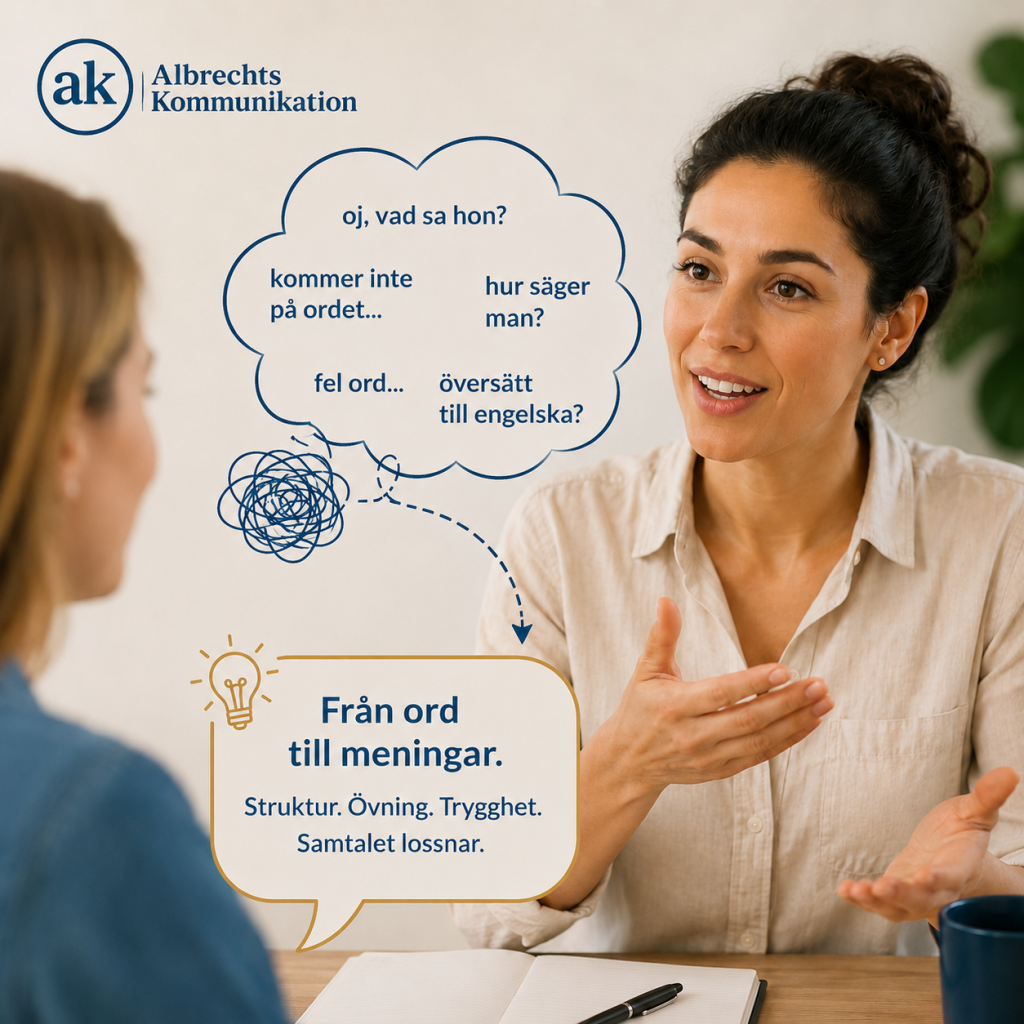
For many people who start taking Swedish lessons, the most difficult stage does not come at the very beginning, but shortly after. You may be able to introduce yourself, answer simple questions and manage certain everyday situations. But as soon as the conversation becomes a little faster and less predictable, it can feel as if the Swedish language slips away.
This is where many international employees and private learners find themselves at A1–A2 level: you know some Swedish, but you still do not feel comfortable using the language freely. In this part of our blog series about Swedish language courses, we look at what happens in this phase — and how you can move forward.
Why Swedish fluency stalls after beginner level
This is also why this level can feel so frustrating. You listen and follow the conversation at first, but lose track when the pace increases. You want to say something, but the words come slowly or in the wrong order. Sometimes you manage to form the sentence, but still hear: “Can we take this in English?”
It is easy to feel that you are not making progress. Our students sometimes tell us that they feel frustrated at this stage. But it is important to remember that this is often a natural part of a larger development process.
Why more words are not always enough in a Swedish language course
If we borrow a perspective from Processability Theory, this becomes quite logical. Language develops step by step. First, there are individual words and memorised chunks. Then the learner needs to understand how words actually connect to each other in phrases and simple sentences.
This means that learning more vocabulary is not always what makes the biggest difference at this stage. Often, it is more important to build stable sentence patterns that can be used again and again until they become more automatic.
From fixed phrases to safe improvisation in Swedish
That is why we like working with structured patterns and safe improvisation at this level. Not improvisation in the sense of “talk freely about anything”, but improvisation within clear frames. For example:
Jag brukar… — I usually… På jobbet behöver jag… — At work I need… I helgen spelade vi… — Last weekend we played… Jag håller med, men… — I agree, but… Ska vi ta en kaffe efter mötet? — Shall we grab a coffee after the meeting?
When patterns like these are repeated, varied and moved between different situations, learners often begin to speak more spontaneously without every sentence feeling like a small project. This is also very much in line with the CEFR description of A1–A2: basic sentence patterns, memorised phrases, frequent routines and simple techniques for starting, maintaining and ending short conversations.
Everyday Swedish and Business Swedish in real situations
At this stage, everyday Swedish becomes very important. For international employees working in Business Swedish environments, this often becomes clear in very concrete situations: the coffee break at work, the short morning meeting, small talk in the corridor, a question to IT, an email from preschool or a conversation at the healthcare centre.
These are the situations where many people feel that they “know Swedish” on paper, but still cannot quite find their footing. That is why we like working with dialogues and situations that actually resemble the learner’s everyday life — it is in these contexts that the language becomes useful, and this is often where motivation increases as well.
Swedish pronunciation classes that build confidence
At this level, we also think it is the right time to work more with pronunciation. Not because anyone has to sound “completely Swedish”, but because intelligibility makes a big difference to both confidence and fluency.
When pronunciation, rhythm and stress become a little clearer, two things often happen at the same time: other people understand more of what you say, and you yourself hear more of what is said back to you. In other words, Swedish pronunciation classes help in both directions. The CEFR descriptions of A2 capture this quite well: pronunciation is often clear enough to be understood, but repetition may still be needed. That is exactly why pronunciation training can be so valuable at this stage.
Workplace Swedish for meetings, coffee breaks and short conversations
When we work with learners at this level, we therefore try to combine four things: clear sentence patterns, real situations, listening and pronunciation. We may work with role plays, short dialogues, recurring phrases, follow-up questions, repetitions and small variations where the learner gradually carries more of the conversation independently.
It is important that the lesson feels warm and encouraging, but also clear. There should be a direction. You should notice what you are practising — and why. That is often when progress starts to feel real.
Swedish lessons for international employees require patience and direction
The most important thing we want to say to anyone who recognises this stage is this: this phase is not a sign that you are bad at languages. Quite the opposite. It often means that you have built a foundation in Swedish and are now building on it — and that needs time and patience.
But it is possible. And once speaking begins to loosen up after this period, Swedish often starts to feel much more like a language you can actually live in — not just something you have studied.
Do you or your company want to take the next step in Swedish?
If this is where you are right now, or if your company has international employees at this stage, the right structure can make a significant difference. Swedish language classes at this level need to be both safe and challenging in the right way: not too easy, not too abstract, but close to the language you actually want to use in everyday life and at work. We have developed specific materials adapted to different levels and goals. Get in touch if this sounds interesting.
Have a lovely rest of the week. Kind regards, Albrechts Kommunikation