

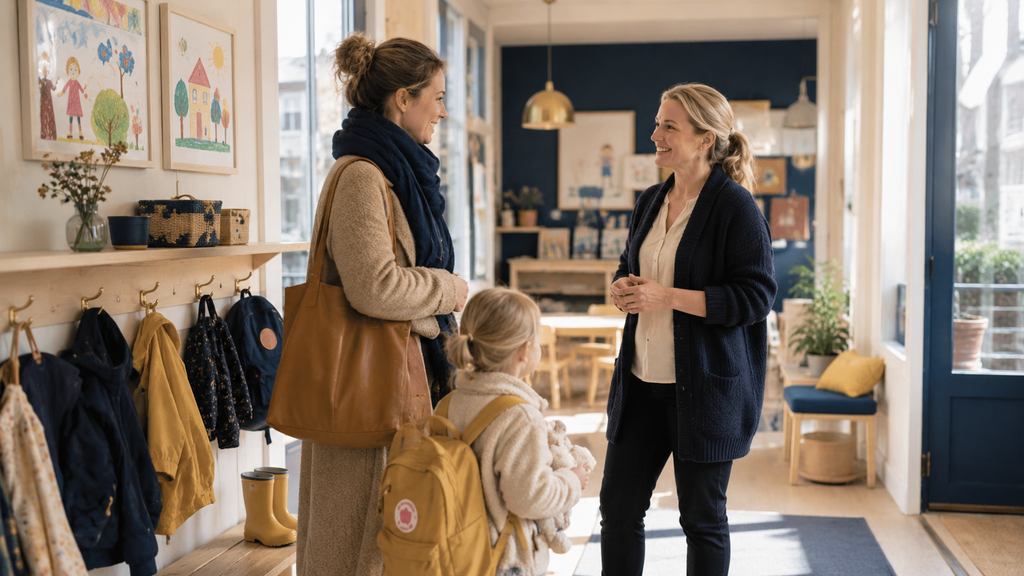
At Albrechts Kommunikation, we regularly hear from students who would like to feel more comfortable using Swedish at preschool. That is not surprising. When you pick up your child from preschool, speaking Swedish feels natural. It is the language the staff use with the children, and many of the children around you will not be able to follow a conversation in English. And of course, the conversations are often about things that matter: sleep, food, clothes, mood, illness, conflicts and how the little ones’ day has been.
In this post, we go through a typical preschool day from morning to afternoon. At the end, you will also find three longer audio files where you can listen to the phrases, repeat them and practise your pronunciation.
When you drop your child off in the morning
If we start with morning drop-off, it is often quite brief; one of the adults helps your child take off their outdoor clothes, other children arrive at the same time and the staff try to get an idea of how the morning has been.
But the conversation is still important because you exchange information about things that may affect the day.
For example, you can say:
Erik sov lite dåligt i natt.
Erik didn’t sleep very well last night.
Han är ganska trött i dag.
He is quite tired today.
Hon åt inte så mycket frukost i morse.
She didn’t eat very much breakfast this morning.
Han var lite ledsen när vi gick hemifrån.
He was a little upset when we left home.
Hon är på bra humör i dag.
She is in a good mood today.
If there is anything practical the staff need to know, you can add:
Han har extrakläder i väskan.
He has spare clothes in his bag.
Vi har tagit med oss regnkläder.
We have brought rain clothes.
Hon behöver ha mössa på sig om ni går ut.
She needs to wear a hat if you go outside.
Jag hämtar lite tidigare i dag.
I’ll pick him/her up a little earlier today.
You can also ask about the plans for the day:
Vad ska ni göra i dag?
What are you going to do today?
Ska ni vara ute i dag?
Are you going to be outside today?
Ska ni gå någonstans?
Are you going anywhere?
När äter ni lunch?
When do you have lunch?
Ska barnen vila efter lunch?
Are the children going to rest after lunch?
This is fairly simple Swedish, but that is exactly why it works so well. You do not need to turn drop-off into a long conversation. The aim is to be able to give relevant information and understand the most important parts of the answer.
The staff may, for example, answer:
Vi tänkte gå till parken efter fruktstunden.
We were thinking of going to the park after the fruit break.
Vi blir nog ute större delen av förmiddagen.
We’ll probably be outside for most of the morning.
I dag ska vi måla och sedan gå ut efter lunch.
Today we’re going to paint and then go outside after lunch.
Vi hör av oss om han verkar trött idag.
We’ll get in touch if he seems tired today.
When something happens during the day
Hopefully, you will not hear anything from preschool until it is time to pick your child up.
But sometimes the phone rings.
Children get ill, fall over, become unusually tired or need to be picked up earlier. These kinds of conversations can feel more difficult in Swedish because you are not prepared and suddenly need to understand what has happened.
A typical conversation might sound like this:
Preschool: Hej, det är Sara från förskolan. Jag ringer om Erik.
Hi, this is Sara from preschool. I’m calling about Erik.
You: Jaha, okej. Har det hänt något?
Oh, okay. Has something happened?
Preschool: Han verkar inte riktigt må bra. Han är väldigt trött och vi tog tempen för en stund sedan. Han har 38,2.
He doesn’t seem to be feeling very well. He is very tired and we took his temperature a little while ago. It’s 38.2.
You: Okej. Behöver jag hämta honom?
Okay. Do I need to pick him up?
Preschool: Ja, det vore bra om du kan komma så snart du har möjlighet.
Yes, it would be good if you could come as soon as you can.
You: Absolut. Jag kan vara där om ungefär trettio minuter.
Absolutely. I can be there in about thirty minutes.
Preschool: Bra. Vi låter honom vila här tills du kommer.
Good. We’ll let him rest here until you arrive.
You: Tack. Jag kommer så fort jag kan.
Thank you. I’ll come as soon as I can.
There are a few useful phrases here that work in many situations:
Har det hänt något?
Has something happened?
Hur mår hon nu?
How is she feeling now?
Har han slagit sig?
Has he hurt himself?
Har hon feber?
Does she have a fever?
Behöver jag hämta honom?
Do I need to pick him up?
Jag kommer så fort jag kan.
I’ll come as soon as I can.
You may also need to ask the person to explain:
Förlåt, kan du säga det en gång till?
Sorry, could you say that again?
Vad menar du med att han är hängig?
What do you mean when you say he is hängig?
Hur hög feber har hon?
How high is her temperature?
När hände det?
When did it happen?
As in many situations, it is useful to be able to ask questions to check that you have understood correctly.
When you pick your child up in the afternoon
There is often a little more time at pick-up.
This is also where many international parents want to feel more confident in their Swedish. You may want to know how your child has been feeling, what the group has done, whether your child has eaten and slept or how things have gone with the other children.
The simplest question is:
Har det gått bra i dag?
Has everything gone well today?
You can then ask more specific questions:
Hur har Erik haft det i dag?
How has Erik been today?
Har han varit glad?
Has he been happy?
Hur skötte han sig i dag?
How did he behave today?
Har hon lekt bra med de andra barnen?
Has she played well with the other children?
Vad har ni gjort i dag?
What have you done today?
Åt han bra till lunch?
Did he eat well at lunch?
Sov hon efter lunch?
Did she sleep after lunch?
Var ni ute länge?
Were you outside for long?
Hände det något särskilt?
Did anything particular happen?
The staff’s answers may be quite everyday:
Det har gått jättebra.
It has gone really well.
Han var lite ledsen efter lunch, men sedan gick det över.
He was a little upset after lunch, but then it passed.
Hon lekte mycket med Lisa och Nora i dag.
She played a lot with Lisa and Nora today.
Han åt väldigt bra till lunch.
He ate very well at lunch.
Hon ville inte sova, men hon vilade en stund.
She didn’t want to sleep, but she rested for a while.
De var ute nästan hela förmiddagen.
They were outside for almost the whole morning.
Han blev lite osams med ett annat barn, men de löste det ganska snabbt.
He had a small disagreement with another child, but they sorted it out quite quickly.
This is also where you hear many small words and expressions that are typical of natural Swedish:
Jaha!
Nähä?
Vad roligt!
Vad skönt.
Oj då.
Jaså?
Du skojar!
For example:
– Han åt faktiskt två portioner till lunch.
He actually ate two portions at lunch.
– Jaha! Det brukar han aldrig göra hemma.
Oh! He never usually does that at home.
Or:
– Hon sov inte så bra idag på vilostunden.
She didn’t sleep very well during rest time today.
– Nähä? Tack för att du sa till.
Oh? Thanks for letting me know.
Three audio exercises – listen and repeat
Instead of lots of short audio clips, we have collected the phrases into three longer sections. Listen to the whole section first and then try repeating the sentences out loud.
Audio 1 – morning drop-off
Vad ska ni göra i dag?
What are you going to do today?
Ska ni vara ute?
Are you going to be outside?
Erik sov lite dåligt i natt.
Erik didn’t sleep very well last night.
Han är ganska trött i dag.
He is quite tired today.
Han åt inte så mycket till frukost.
He didn’t eat very much for breakfast.
Jag hämtar lite tidigare i eftermiddag.
I’ll pick him up a little earlier this afternoon.
Ha en bra dag!
Have a good day!
Audio 2 – when preschool calls
Jaha, okej. Har det hänt något?
Oh, okay. Has something happened?
Hur mår han nu?
How is he feeling now?
Har han feber?
Does he have a fever?
När hände det?
When did it happen?
Behöver jag hämta honom?
Do I need to pick him up?
Förlåt, kan du säga det en gång till?
Sorry, could you say that again?
Okej, jag förstår.
Okay, I understand.
Jag kommer så fort jag kan.
I’ll come as soon as I can.
Audio 3 – afternoon pick-up
Har det gått bra i dag?
Has everything gone well today?
Hur har hon haft det?
How has she been?
Vad har ni gjort i dag?
What have you done today?
Åt hon bra till lunch?
Did she eat well at lunch?
Har hon lekt bra med de andra barnen?
Has she played well with the other children?
Hände det något särskilt?
Did anything particular happen?
Jaha, vad roligt!
Oh, how nice!
Då ses vi i morgon!
See you tomorrow, then!
From a few phrases to a real conversation
This is, of course, only a small sample.
A real conversation at preschool can go in many different directions. The staff may tell you about a conflict, ask whether something has happened at home or use a word you have never heard before. Your child may be standing next to you wanting to go home while three other parents walk through the door at the same time.
That is why everyday Swedish is about more than memorising ready-made sentences. You also need to understand the answers, ask follow-up questions and continue the conversation when it does not go exactly as you expected.
If you would like to feel more comfortable with this kind of Swedish, we can practise situations that actually occur in your own life. With a private Swedish teacher, lessons can, for example, be based on conversations at preschool, at work, at the health centre or other situations where you would like to feel more confident.
At Albrechts Kommunikation, we offer personal Swedish lessons online and in Stockholm.
Book a free taster lesson and consultation, and we can talk about what you would like to improve.