

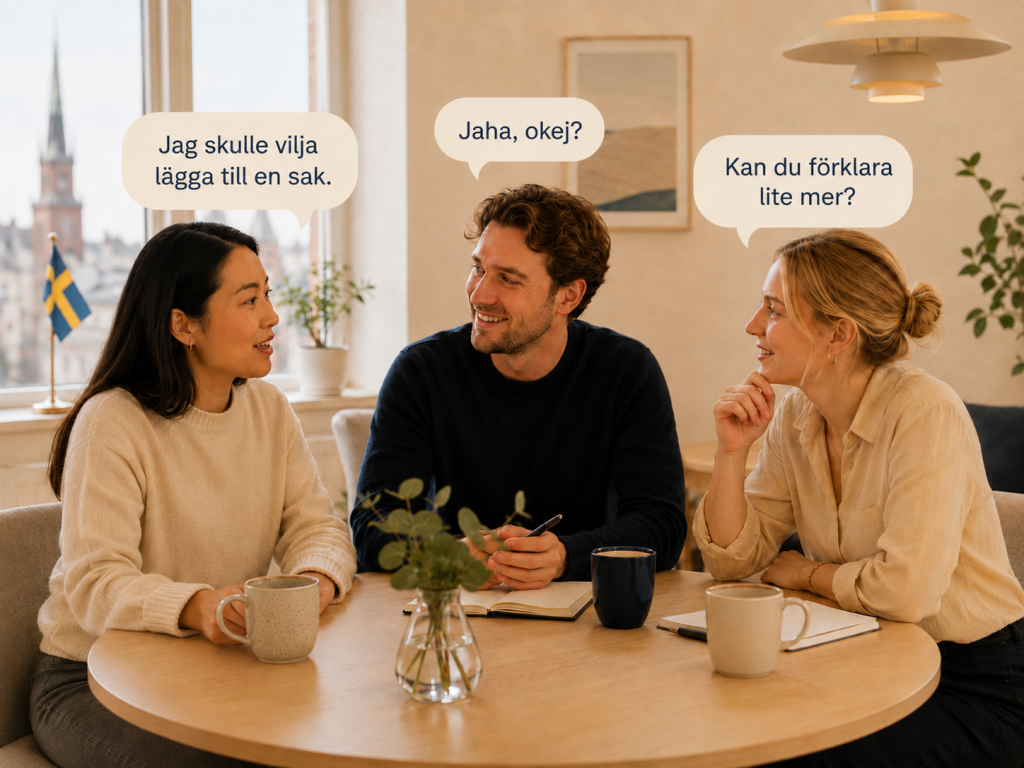
You are sitting in a meeting at work. You understand most of what is being said – but when you want to contribute, the conversation suddenly moves quickly. Someone else starts speaking, you lose the sentence you had prepared, and in the end it feels easier to stay quiet.
Sound familiar?
Sooner or later, being able to participate in meetings in Swedish can make a real difference. It makes everyday communication at work easier, but it can also open up new career opportunities. Several of our students who want to move into management or take on greater responsibility tell us that Swedish becomes increasingly important as their careers progress.
The good news is that you do not need perfect Swedish before you start contributing.
With some useful Swedish meeting vocabulary, you can take the floor, agree, disagree politely, ask for clarification and help summarise a discussion – even at B1 level.
Before the meeting – useful Swedish vocabulary
A Swedish meeting often starts long before everyone sits down around the table.
Someone may need to:
- boka ett mötesrum – book a meeting room
- sammankalla till ett möte – call a meeting
- skriva en dagordning / agenda – prepare an agenda
- skicka ut information – send information to the participants
Some other useful words are:
ett möte – a meeting
ett webbmöte – an online meeting
en projektgrupp / ett team – a project group / team
en dagordning / en agenda – an agenda
en lägesrapport – a status report
ett mötesprotokoll – meeting minutes
You may not be the person organising the meeting, but understanding these words makes it much easier to know what is happening and what is expected of you.
Har du hunnit läsa dagordningen?
Have you had time to read the agenda?
Jag skickade en uppdaterad agenda i morse.
I sent an updated agenda this morning.
Vi börjar med lägesrapporten.
We’ll start with the status report.
During the meeting – how to take the floor
For many learners, the difficult part is not having an opinion. It is finding a natural way into the conversation.
Try phrases such as:
Jag skulle vilja lägga till en sak.
I’d like to add something.
Jag har en idé.
I have an idea.
Kan man tänka så här att…?
Could we look at it this way…?
Skulle vi kunna…?
Could we…?
Vad tror ni om det här?
What do you think about this?
Vad sägs om att…?
How about…?
You can also connect your comment to something another person has already said:
När du pratade om det där tänkte jag på en sak…
When you were talking about that, something occurred to me…
Jag håller med om det du sa om…
I agree with what you said about…
Jag fick en idé när du pratade om…
I got an idea when you were talking about…
These phrases make it much easier to enter the conversation without having to produce a long, perfectly prepared statement.
When you agree
This part is usually quite straightforward:
Ja, precis!
Yes, exactly!
Absolut.
Absolutely.
Verkligen.
Definitely.
Det stämmer.
That’s right.
Det håller jag med om.
I agree with that.
You can then continue:
Det håller jag verkligen med om. Jag tror också att…
I completely agree. I also think that…
That gives you a natural way to acknowledge your colleague before adding your own point.
When you disagree – without starting a war
Swedish workplace communication can often be fairly indirect.
Saying:
Du har fel.
You’re wrong.
is grammatically perfect Swedish.
It is not always the smoothest choice in a meeting.
Instead, try:
Ja, jag förstår hur du menar, men…
Yes, I see what you mean, but…
Det har du rätt i. Men man kan också fundera på…
You’re right about that. But we could also consider…
Jo, visserligen, men…
Yes, admittedly, but…
Jag har en annan uppfattning i den här frågan.
I have a different view on this issue.
Jag är inte helt säker på att jag håller med.
I’m not entirely sure I agree.
This is an important part of Swedish for meetings: disagreeing clearly while still showing that you have listened to the other person.
When you do not hear or understand something
This may be the most useful skill of all.
You do not have to pretend that you understood.
Try:
Förlåt, jag hörde inte riktigt.
Sorry, I didn’t quite hear that.
Jag förstår inte riktigt vad du menar. Kan du förklara lite mer?
I’m not quite sure what you mean. Could you explain a little more?
Jag uppfattade inte vad du sa om projektet.
I didn’t catch what you said about the project.
Menade du att vi ska ändra planen?
Did you mean that we should change the plan?
Asking one extra question is usually much better than leaving the meeting without knowing what everyone has agreed on.
And then there is real Swedish: jaha, nähä and du skojar!
Real meetings are not made up entirely of formal phrases.
You may hear conversations like this:
– De sa att leveransen blir klar redan imorgon.
They said the delivery will be ready tomorrow already.
– Jaha! Det var snabbare än jag trodde.
Oh, right! That was faster than I expected.
Or:
– Kunden vill flytta mötet till nästa vecka.
The client wants to move the meeting to next week.
– Nähä… då måste vi nog ändra planen.
Oh… then we’ll probably have to change the plan.
Or perhaps:
– De vill göra om hela presentationen till fredag.
They want us to redo the whole presentation by Friday.
– Du skojar!
You’re joking!
Small reactions like these make your Swedish sound much more natural. They show that you are following the conversation and reacting immediately, even when you do not have a long comment ready.
Making a decision
Towards the end of the meeting, the group often needs to agree on what happens next.
You may hear:
Ska vi säga så då?
Shall we agree on that, then?
Kan vi enas om att…?
Can we agree that…?
Då tycker jag att vi bestämmer att…
Then I suggest we decide that…
And then comes another very useful question:
Vem gör vad?
Who does what?
After the meeting – summarise and follow up
When the meeting ends, there is often still some work to do:
- sammanfatta – summarise
- skriva / skicka mötesprotokoll – write / send the meeting minutes
- bestämma nästa steg – decide on the next steps
- följa upp – follow up
For example:
Jag sammanfattar det vi har bestämt och skickar ut det efter mötet.
I’ll summarise what we have agreed and send it out after the meeting.
Nästa steg är att Anna kontaktar kunden och att vi följer upp på fredag.
The next step is for Anna to contact the client, and we’ll follow up on Friday.
This is often where you discover whether you really understood what happened during the meeting.
A short Swedish meeting dialogue
Here is what several of these phrases might sound like together:
Anna: Jag tycker att vi ska skjuta upp lanseringen en vecka.
I think we should postpone the launch by one week.
David: Ja, jag förstår hur du tänker, men skulle vi kunna behålla det gamla datumet och minska omfattningen i stället?
Yes, I see what you mean, but could we keep the original date and reduce the scope instead?
Anna: Det är möjligt. Vad säger ni andra?
That’s possible. What do the rest of you think?
Sara: Jag håller faktiskt med David. Men jag förstod inte riktigt vad du sa om kundens deadline. Kan du förklara?
I actually agree with David. But I didn’t quite understand what you said about the client’s deadline. Could you explain?
Anna: Absolut. Kunden behöver den första versionen på måndag, men allt behöver inte vara färdigt.
Absolutely. The client needs the first version on Monday, but everything does not have to be finished.
Sara: Jaha! Då är jag med.
Ah, okay! Now I understand.
David: Ska vi säga att vi skickar första versionen på måndag och resten på fredag?
Shall we say that we send the first version on Monday and the rest on Friday?
Anna: Ja, det gör vi.
Yes, let’s do that.
This is not advanced Swedish.
But it is functional Swedish – and that is what makes the difference in a real meeting.
From understanding the meeting to taking part in it
You now have a number of phrases that can help you participate more actively in a Swedish meeting.
The next step is being able to use them naturally when the discussion moves quickly and you need to react in real time.
That is also where practising workplace Swedish becomes particularly valuable: instead of simply memorising vocabulary, you practise the situations you actually encounter at work.
At Albrechts Kommunikation, we provide practical Swedish training for international employees and company groups, online and on-site in Stockholm. Training is adapted to the participants’ roles, language levels and real workplace situations.
Swedish training for companies from SEK 745 per hour.
Book a free consultation and we can discuss the format that would work best for your team.